Aim
Vinyl, CCTV, and screen installation.
Museum of Modern Art of Buenos Aires,
2005
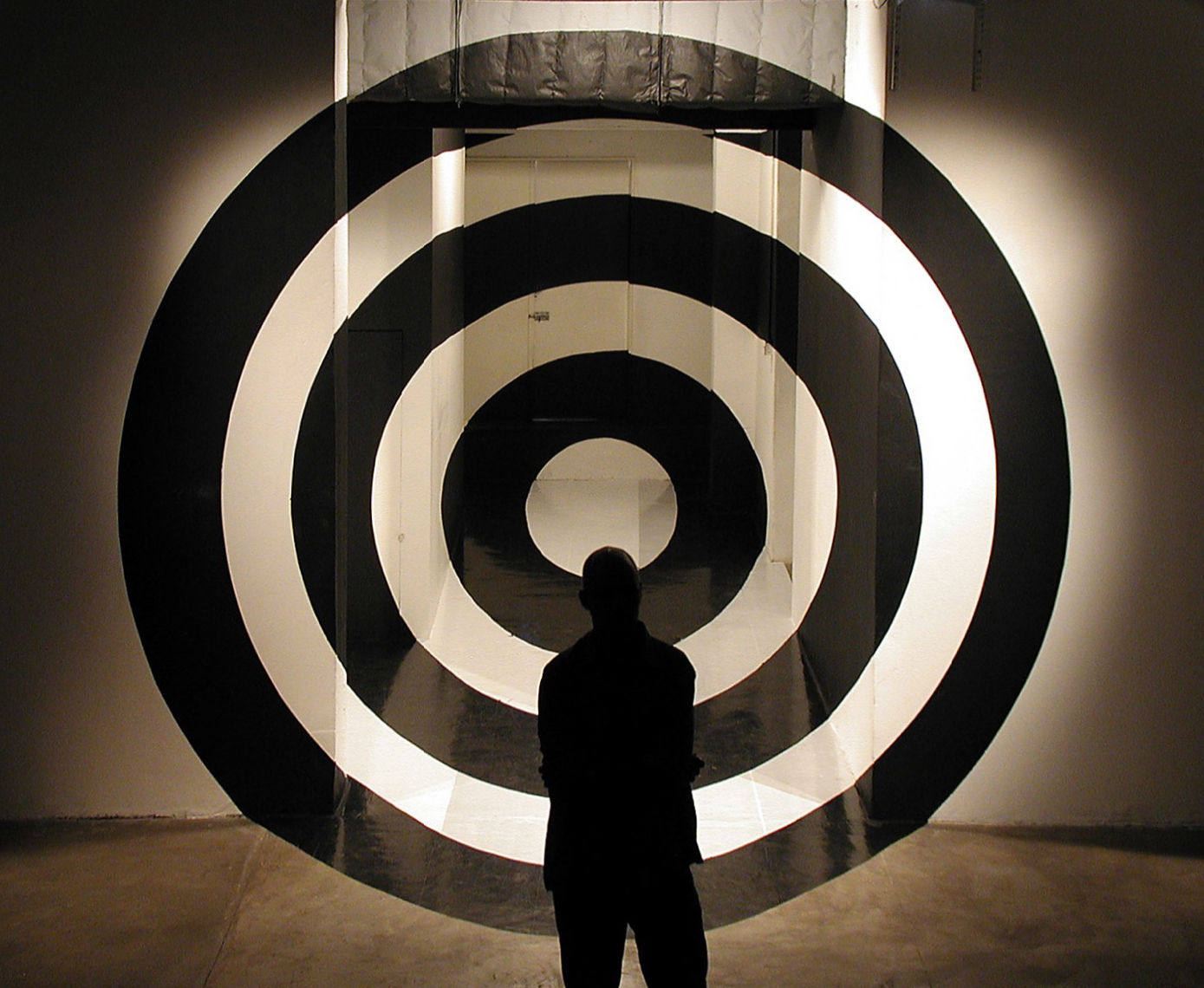
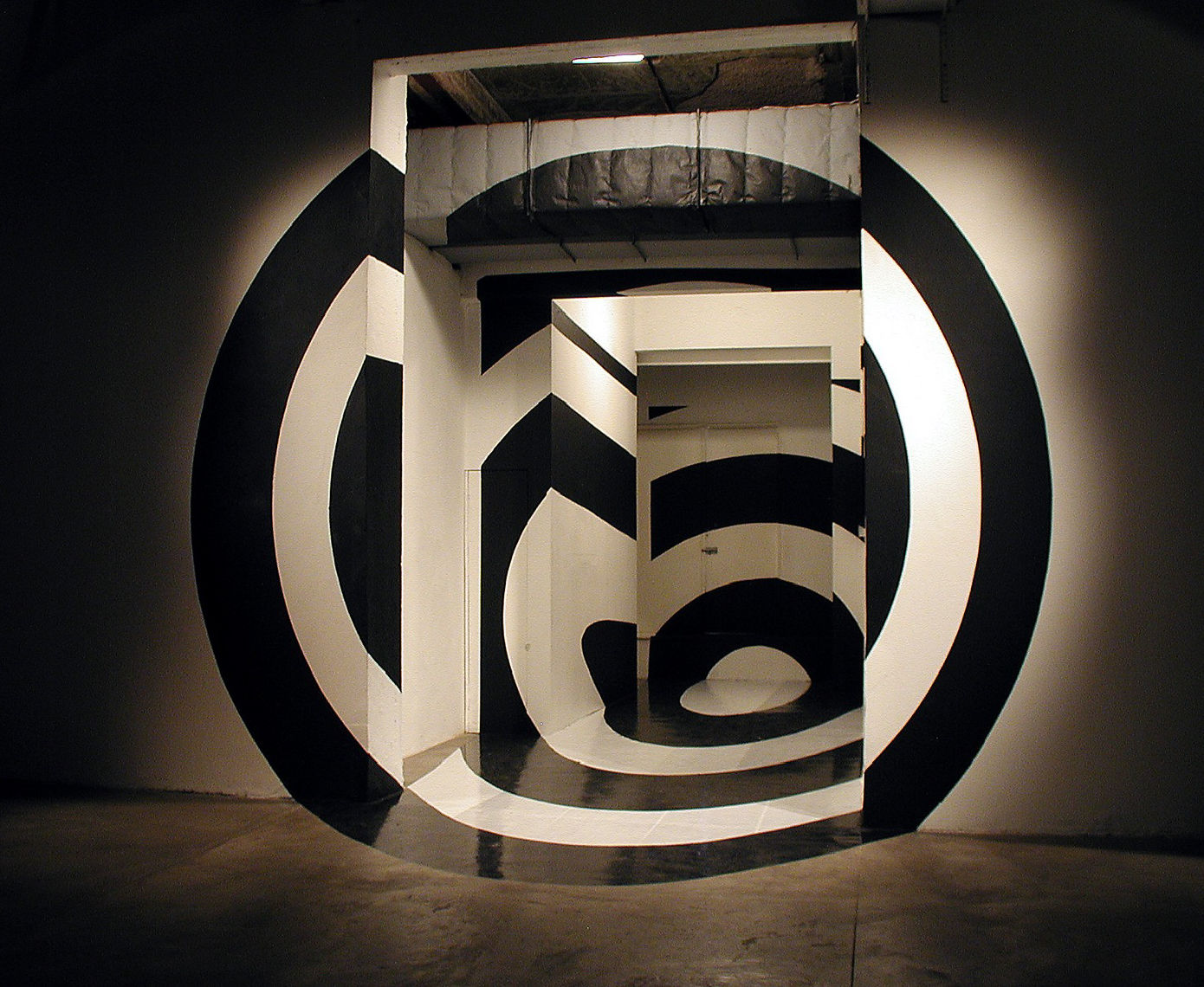

AIM®
The story I wanted to tell you goes more or less like this. A friend told it to me, assuring me it was absolutely true. He had heard it from someone who saw it on television and later confirmed it through the testimonies of neighbors in the area where it happened—the same place where the events I’m about to recount took place. The story was featured on an entertainment show, though I thought it would have fit better on one of those investigative journalism programs.
As soon as I heard the first words of the story, I was reminded of the invention of the telescopic sight. The telescopic sight was invented—or perfected (I might be wrong)—by Philo Remington (1816–1889) for his famous breech-loading rifles. Remington® is the same man who produced the equally legendary typewriters bearing his name, the machines on which Faulkner, Hemingway, and Onetti wrote their works. Gunfire and words in rapid succession.
The telescopic sight was modeled after the circular shapes of the eye—iris and pupil—just as earlier targets and camera lenses had been (though lenses are round, the images they produce are square or rectangular). The same goes for surveillance cameras, though by definition, these are placed out of our reach and thus separate from the human eye. They communicate directly with a screen or an electronic brain.
In the story I was told, a man had set up a system of cameras that recorded him constantly and protected him. If circumstances demanded it, the camera system would trigger a shot that never missed the center of the target. In his patent application, the inventor claimed to have achieved his own utopia: perpetual surveillance. Quoting an English writer, he argued that “surveillance was the artistic form of the millennium” and that “men of good will” should not fear this monitoring but rather encourage it.
As you may have already guessed, the story had a tragic ending: the inventor died because he mistook himself for an intruder. This isn’t hard to understand if we consider that one of the things we know least about is our own backs. In a moment of confusion, he activated a mechanism that—as he himself boasted—eliminated the possibility of error.
The tale seemed tailor-made for a moral lesson, but my friend preferred to talk about other things: the history of cinema, Chaplin’s The King of New York, Doctor Mabuse®. To me, it brought to mind the work of Augusto Zanela because, in his pieces—as in the story I’d been told—there was no longer any guilt in the act of looking nor innocence in what was seen. The one being watched, observed, captured and swept within the camera’s optical field was already virtually guilty. The eye of the camera, meanwhile, was an empty lens devoid of humanity. In his works, the viewer’s gaze never aligned with their body.
Since Zanela lately works almost exclusively with surveillance cameras, we shouldn’t rule out the possibility that the closed-circuit systems in museums are the last refuge where his art comes full circle: the gaze no longer promises pleasure but rather the feeling of having been deceived. Between the virtuality of the real and the reality of all virtuality, between the precision of optical effects and the ambiguity of human perception, between the duration of bodily movement and the spatiality of the gaze, between the delusions of anamorphosis and perspective as delirium, Zanela creates work that has the virtue of being entertaining at first—until, as his game progresses, it becomes one of the last versions of our paranoia.
As a conclusion to the entire experience, Note® is the coded word that triggers the mechanism.
Gonzalo Aguilar
Buenos Aires, 2005
Aim
Wall paint.
Bienal del Museo del Barrio
Nueva York, 2007

Aim
Vinyl, CCTV, and screen installation.
Recording of Edgardo Mercado’s performance.
Festival Theavida
Montpellier, 2011

Aim
Vinyl, CCTV, and screen installation.
Praxis Art Gallery
Miami, 2007

Aim
Vinyl, CCTV, and screen installation.
Pinta Art Fair
Nueva York, 2008

Aim
Installation with bicycle wheel, CCTV, and screen.
ArteBA
Buenos Aires, 2008
