MAMBO [Rotation / Turn / Repetition]
Miranda Bosch Gallery
Buenos Aires, 2015
"There's a certain transparency in dance that always yields a naturalistic vein, whether in aerobic or electronic dances, or in precise steps that blend with the very scores and the swing that emerges from them.
Through repetition, dance is, above all, patterned expressiveness; each person will extract its essence as they can, evoking great libations or measuring themselves in endurance and sensuality".
—Splash in Vitro (fragment)


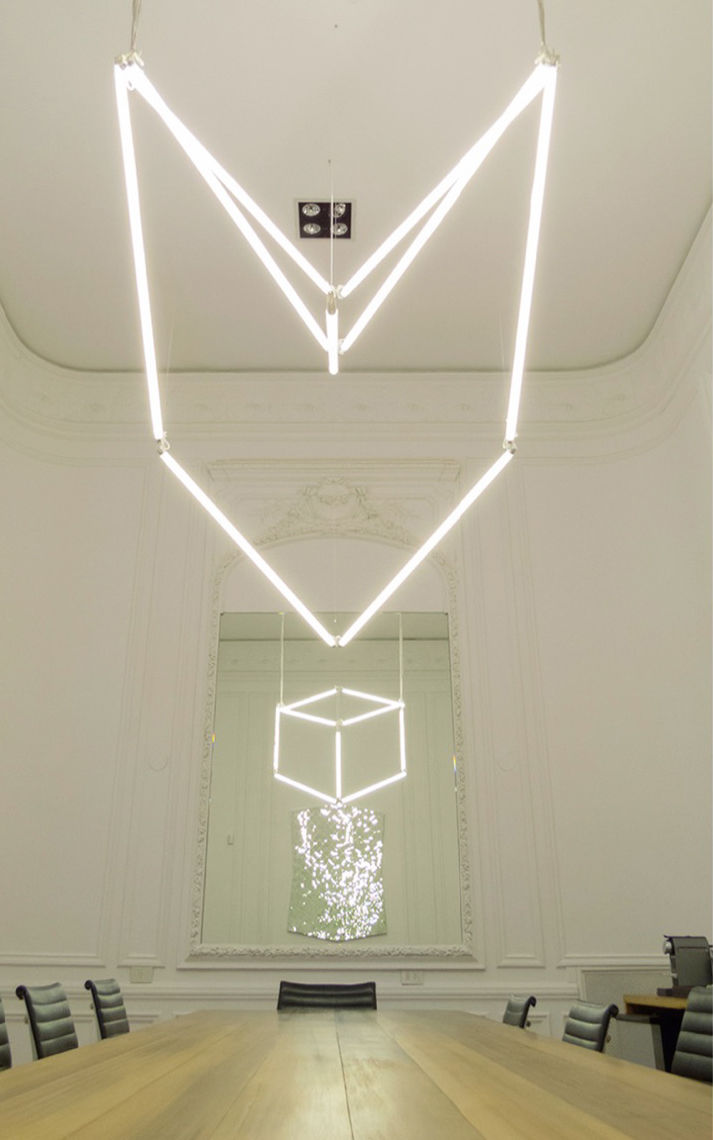


The dancing eye
Splash in Vitro
There’s a certain transparency in dance that always yields a naturalistic vein, whether in aerobic or electronic dances, or in precise steps that blend with the very scores and the swing emerging from them.
Through repetition, dance is, above all, patterned expressiveness; each person will extract its essence as they can, evoking great libations or measuring themselves in endurance and sensuality.
Dance can also liberate entropies, making the world spin in parcels tailored to the body, like tight-fitting pants, revealing in every fold a surprise later to be interpreted by the gaze resting in the cone of perception.
And what happens when repetition becomes expression, a spelling-out of visual assumptions? Will the rhythm be graspable at first glance?
We’ll have to wait for the sun to set, and with music determined not to leave us inert, we’ll notice what we saw, launched into our perception in key: how that danced eye looks. Then, retreat quickly, take distance, and as if through a collimator, fire off steps, turns, leaps. All this will dance in this presentation. Augusto Zanela and Luis Rodríguez dare to suggest that if the danced eye can be seen, the gaze is capable of remembering itself looking.
And the wall filled everywhere, complete, without gaps… In fact, there’s a point where we see a perfect sphere that will immediately be danced for us as we move through the space.
Let’s overexplain now: there are steps to follow. On one hand, the notion of dance, leap, turn. On the other, the language of insistent objects, synaptic mirrors evoking a dense CF layer (hence the glass objects shaped like intrepid globular architectures, and the walls practically subjected to a tangent, releasing the form of their constitutive organisms). Whether through anamorphosis or circularity, geometry gives way to sensual poses.
The wall is circumstantially stained by the matrix of a contradance, painted and repainted in graphite and tape. It quietly reclaims fragments of the mind in the absence of the danced.
Hoisted in a disruptive world, Mambo performs the subcutaneous role of tattooing insistences that would otherwise be ghosts. This directional use of the phallic, resonating with the spectator’s potential as decisive actor, allows us above all to ask—in black and white—the relational question:
Do we dance?